Bedding · Materials · Circularity
Coyuchi’s 2nd Home Program: How Recycled Cotton Fits Into Bedding
A cotton blanket can begin a second chapter when its fibers are recovered and woven into something new. Coyuchi’s 2nd Home program offers a useful case study in textile reuse—and a reminder that recycled content, organic farming, and certification each answer different questions about how bedding is made.
Published November 5, 2026
There is a quiet elegance to an object that does not consider itself finished at the end of its first life. In bedding, that idea is especially tangible: cotton, familiar from sheets, towels, and blankets, can be collected after use, processed into fiber, and returned to the textile stream. Instead of treating a worn household textile as an endpoint, a reuse program can regard it as material with another possible purpose.
Coyuchi’s 2nd Home program provides one example of this approach. Recovered cotton from the program is used in new textiles, including bedding made with a blend of recycled and organically grown cotton. The arrangement is a practical illustration of circularity, a design principle that aims to keep materials in use for longer. It is also an invitation to look more carefully at the language on a blanket’s label: “recycled,” “organic,” and “certified” are meaningful terms, but they describe different things.
Understanding those distinctions helps readers assess claims without expecting any single fiber or certification to tell the whole environmental story. A recycled-content percentage can explain the composition of a textile. A standard such as the Global Recycled Standard can offer assurance about specified parts of the chain of custody and processing. Neither, by itself, tells us everything about a product’s durability, overall footprint, working conditions, or eventual destination.
What does “recycled cotton” mean?
Recycled cotton is fiber recovered from existing textile material or cotton waste and used again in a new product. The feedstock may include post-consumer textiles—items used by households and later collected—or pre-consumer material, such as certain scraps left over from manufacturing. The precise sources and proportions depend on the program and product, so it is sensible to look for clear disclosures rather than assume that every recycled-cotton textile comes from the same stream.
In a bedding blend, recycled cotton may be combined with newly grown cotton. That pairing can help manufacturers work with recovered fiber while creating a textile with the hand, construction, and performance they intend. It also means the finished material is not wholly recycled: the stated percentages matter. A description of 52% recycled cotton and 48% organic cotton, for example, communicates a different composition from a textile made entirely of recycled fiber.
Recycling cotton is not simply a matter of unravelling an old blanket and spinning the exact same fibers into an identical new one. Mechanical recycling often involves sorting, cleaning, and breaking textile material down into fibers. This processing can shorten fibers or leave them less uniform than virgin fiber, which may affect how they can be spun and used. Blending recovered cotton with other cotton can be one way to achieve a workable yarn and a consistent fabric. The details vary by process, so broad claims about all recycled cotton should be treated with care.
There is also a useful distinction between recycled material and reclaimed or reused goods. Reuse keeps an item, or part of it, in service with less transformation. Recycling processes material so it can become an input for another product. Both strategies can help extend the useful life of resources, but they are not interchangeable, and their impacts depend on collection, processing, transport, product design, and what would otherwise have happened to the material.
The 2nd Home idea: a textile with another address
The name “2nd Home” suggests a change in a textile’s role: an item that has served in one household may, through a recovery and processing system, contribute material to a new one. In the context of Coyuchi’s program, the important point is not that every returned blanket becomes a particular new blanket. Rather, recovered cotton is brought back into circulation and used as a material input in new products.
This is a compelling idea because cotton is both familiar and resource-intensive to produce. Growing new fiber requires land, water, and agricultural inputs; the exact demands vary with region, farming practices, weather, and production methods. Using recovered cotton can reduce reliance on newly cultivated fiber in a product’s composition. But “recycled” should not be read as shorthand for impact-free. Collection and sorting require infrastructure, processing takes energy and resources, and transport and finishing also form part of a textile’s life cycle.
The program is best understood as one piece of a broader material strategy rather than a complete answer to textile waste. Circular systems need more than a collection point. They rely on usable recovery routes, transparent accounting, suitable processing, and products designed to remain in service. They also depend on people having practical ways to return or pass along textiles when they no longer need them.
For householders, this prompts a useful question: what happens after the first owner is finished with a blanket? Donation, repair, resale, take-back, recycling, and disposal are different pathways, and each depends on the condition of the textile and the local systems available. A take-back initiative can make recovery more visible, but readers should consult its current terms to learn what items it accepts, how they are handled, and whether a specific product is eligible.
What GRS certification can—and cannot—tell you
The Global Recycled Standard, commonly shortened to GRS, is a voluntary standard used to verify recycled content and address specified environmental and social practices in processing. Its requirements include chain-of-custody controls intended to track material through participating stages of the supply chain. For a bedding shopper, this can make a recycled-content claim more verifiable than a general, unsupported statement.
Certification is most useful when readers understand its scope. A GRS claim is not a universal seal of environmental perfection, nor does it mean that every impact associated with a product has been eliminated. It does not, on its own, prove that a blanket is organic, that it is biodegradable, that it will last a particular number of years, or that it has a smaller total footprint than every alternative. Those questions require different information and, in some cases, a fuller life-cycle assessment.
It is also important not to confuse standards that address different material claims. The Global Organic Textile Standard (GOTS) concerns organic fibers and includes requirements for relevant processing stages. The Global Recycled Standard focuses on recycled content and related chain-of-custody and processing criteria. A product may make claims connected to more than one standard, but each claim should be read separately and checked against the product’s actual certification information.
Certification details can change as products and supply chains change. Readers who want to evaluate a claim closely can look for the standard name, the product or scope covered, the stated recycled percentage, and any certificate or certification-body information provided by the brand. If a page offers only a broad sustainability phrase without specifying what is certified, it is reasonable to seek clarification.
- Recycled-content percentage: The share of the stated material that comes from recycled sources.
- Standard and scope: Which requirements apply and what part of the supply chain is covered.
- Organic claim: Whether newly grown cotton is certified organic, and under which relevant standard.
- Product-level information: Whether the claim applies to the particular blanket, rather than to a brand or program generally.
Reading a recycled-and-organic cotton blend
A blend of recycled cotton and organic cotton brings together two different sourcing stories. The recycled portion represents fiber recovered from an earlier material stream. The organic portion refers to cotton grown under a defined organic agricultural system, subject to the relevant certification and processing requirements where stated. One is not a substitute for the other; each describes a different stage in the material’s history.
That combination can be appealing to readers interested in both reclaimed resources and organic agriculture. It can also make clear labeling particularly important. “Organic cotton” in a product name does not necessarily mean every fiber in a blend is organic, just as the presence of recycled cotton does not mean the entire textile has been made from recovered material. The composition label is the most direct starting point.
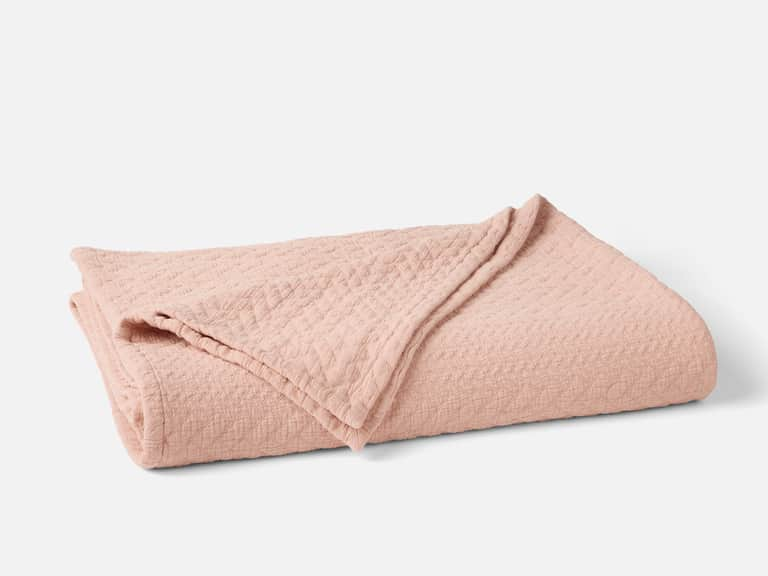
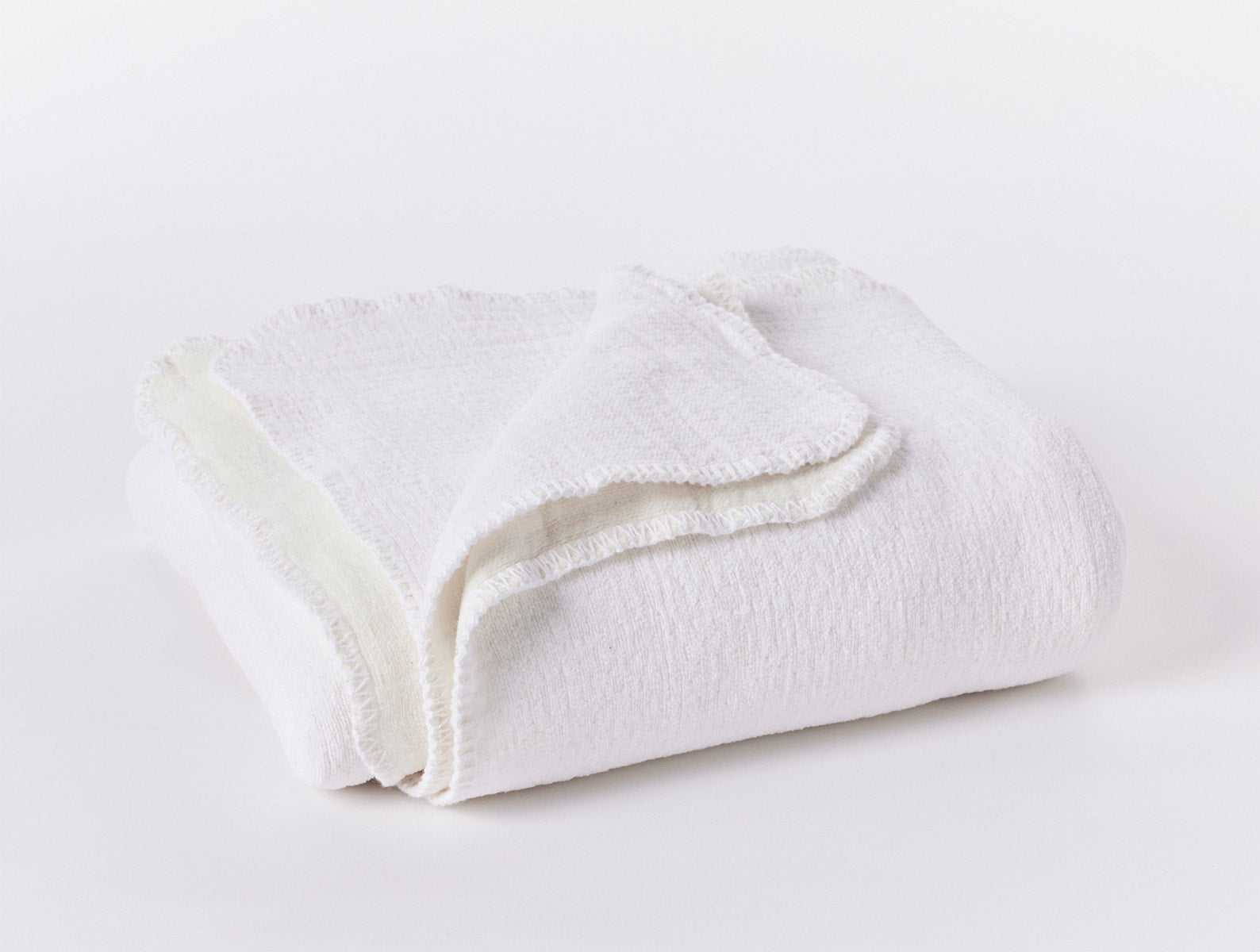
For a concrete example, the Full Circle Recycled Cotton Blanket is described as a blend of 52% recycled cotton and 48% organic cotton, with the fabric woven in Germany. Its recycled portion is associated with Coyuchi’s 2nd Home program, and the product information identifies GRS certification for the recycled content. Those details help explain how program, fiber composition, and certification relate, without suggesting that any one of them answers every question about impact.
The blanket’s brushed finish and woven construction are also relevant to the everyday experience of bedding. A material story is not separate from use: a layer that feels comfortable, suits the climate, and is cared for appropriately may be more likely to remain in rotation. At the same time, a tactile description cannot establish a product’s environmental performance. Good textile literacy keeps both ideas in view—the experience of using the object and the evidence behind its sourcing claims.
Durability is part of the sustainability conversation
A recycled-content claim describes where material comes from; it does not guarantee how long a blanket will last. Durability depends on fiber quality, yarn construction, weave or knit, finishing, seams, frequency of use, washing habits, and the conditions in which the textile is stored. These factors are practical, not glamorous, but they shape whether a blanket remains useful season after season.
Before caring for a recycled-cotton blanket, follow the instructions supplied for that specific item. If the care guidance permits machine washing, a gentle cycle and a lower drying temperature may help reduce unnecessary wear, though the manufacturer’s directions should take priority. Avoid treating every cotton blend the same: recycled fiber, finishes, dyes, and construction can make one textile’s care requirements different from another’s.
Small habits can extend a blanket’s useful life. Rotate bedding when possible, address stains promptly using suitable methods, and repair loose stitching before a minor fault becomes a larger one. Store clean textiles in a dry place, and avoid keeping them compressed for long periods if that could damage their texture. When a blanket is no longer wanted but remains usable, passing it on may keep it in service without sending it immediately into a recycling system.
There is no single care routine that suits every textile. A recycled-cotton blend may be washable, while a wool blanket or a structured comforter may require more cautious handling. The label is not an afterthought: it is a practical guide to protecting the object and preserving the material value already invested in it.
Questions to ask about end of life
“Circular” can sound like a promise that materials will move endlessly from one product to the next. In practice, fibers do not circulate indefinitely without losses. Each round of processing can affect fiber length and quality, and blends, dyes, finishes, trims, and construction can complicate separation. The realistic aim is often to keep a material useful for longer and make recovery more feasible—not to claim a perfect, closed loop.
When considering a take-back scheme or recycling route, check what it accepts and what happens after collection. Does it take only particular brands or fiber types? Must items be clean or intact? Is the material reused, mechanically recycled, downcycled into another application, or handled through a different route? Specific answers are more informative than the general assertion that a product is “circular.”
End-of-life planning can begin before a purchase. A blanket with clear fiber labeling and a straightforward construction may be easier to identify and sort later than one with an uncertain mixture of materials. Choosing a versatile size and style can also make a textile more likely to stay in use if it moves from a bed to a sofa or another household. The most circular item is not necessarily the one with the most elaborate claim; it is often the one that is used, cared for, and passed along thoughtfully.
A measured way to assess environmental claims
Recycled cotton can be a meaningful part of a more resource-conscious bedding system. It gives existing fiber another use and can reduce the need for an equivalent amount of newly grown cotton in a blended textile. Yet the size of any environmental benefit depends on how the recycled fiber is collected, processed, transported, and incorporated, as well as what material and production route it replaces. Without comparative, product-specific evidence, it is better to describe the potential than to declare a definitive saving.
Organic cultivation and recycled content likewise should not be collapsed into one broad verdict. Organic certification can help readers understand agricultural and processing requirements for the fibers it covers. Recycled-content certification can support confidence in the recovered material claim and its chain of custody. Neither eliminates the need to ask about manufacturing, durability, care, packaging, or eventual recovery.
This measured approach need not diminish the appeal of a well-made blanket. On the contrary, it allows the qualities of the object—its texture, weight, and place in a home—to sit beside a credible account of its materials. The language of sustainability becomes more useful when it is precise enough to be checked and modest enough to acknowledge what remains unknown.
A reader’s checklist for recycled-cotton bedding
- Read the full fiber composition and note the percentage of recycled cotton.
- Look for clarity about whether the recovered material is pre-consumer, post-consumer, or a combination, when that information is available.
- Check which certification applies to the recycled claim and whether the product-level details are provided.
- Read any organic-cotton claim separately, including its percentage and certification information.
- Consider construction, care requirements, and likely everyday use—not just the material’s origin.
- Look for specific take-back, repair, resale, or recycling instructions rather than assuming a blanket can be returned anywhere.
- Keep the product-care label and use it to help the textile last.
The wider meaning of a second life
Coyuchi’s 2nd Home program makes textile reuse legible in a place where it matters: the everyday home. Its example shows how recovered cotton may enter new bedding alongside organic cotton, and how a recycled-material standard can help verify claims as material moves through a supply chain. It also illustrates why a label should be read as a set of specific statements, not as a complete verdict on a product.
For readers, the most useful questions are straightforward: what is the blanket made from, how much of it is recycled, what does the certification cover, how should it be cared for, and what options exist when it is no longer needed? Asking those questions does not require expertise in textile engineering. It requires only a willingness to look beyond a single appealing word.
In a bedroom, circularity is not an abstract ideal. It is the story of a fiber’s past, the care it receives in the present, and the possibilities available for its future. A thoughtful approach to bedding gives each of those chapters room—without mistaking one meaningful step for the whole journey.